
Chris J. Krisinger | March 15, 2026
Not so long ago, Virginia voters in 2020 went to the polls in a statewide referendum to overwhelmingly approve a state constitutional amendment that Virginia move to employ a bipartisan commission to draw its congressional boundaries rather than party politicians of the Virginia General Assembly.
That amendment — known as Virginia Question 1 — overwhelmingly passed with 65.69% of the vote, winning a majority of support in every county and independent city save for “deep blue” suburban Arlington County (where it still got 45%).
When the amendment passed, many Virginia Democrats, some Republicans, and anti-gerrymandering backers had worked for almost a decade to take away the General Assembly’s authority to draw the congressional districts and give it to an outside bipartisan commission made up of both legislators and civilians. Supporters from both sides called it a bipartisan step to restore some measure of faith in the democratic process, producing fairer maps with less potential to be drawn to favor one party or the other. The intent was to take map-drawing power from politicians with a vested interest in picking their constituents and create a process governed by constitutional rules. Virginia Question 1 was no ordinary statute; it was a constitutional commitment, ratified by Virginia voters.
But after gaining full control of the statehouse in last fall’s off-year elections, Virginia Democrats are now attempting to reverse what that majority of Virginians voted for and revert back to the General Assembly drawing congressional maps behind politically partisan closed doors and doing so by advancing efforts to repeal that 2020 amendment to Virginia’s constitution.
Democratic state legislators propose their own new constitutional amendment to again allow the Virginia General Assembly to redraw congressional districts outside the normal 10-year redistricting process. Democrats, along party-line votes in both chambers of the General Assembly, paved the way for a statewide referendum — with election day on April 21 — for voters to decide whether or not Virginia should make a limited return to its gerrymandering past. Their efforts are advertised as part of a national Democratic reaction to Republican-led redistricting efforts in other states.
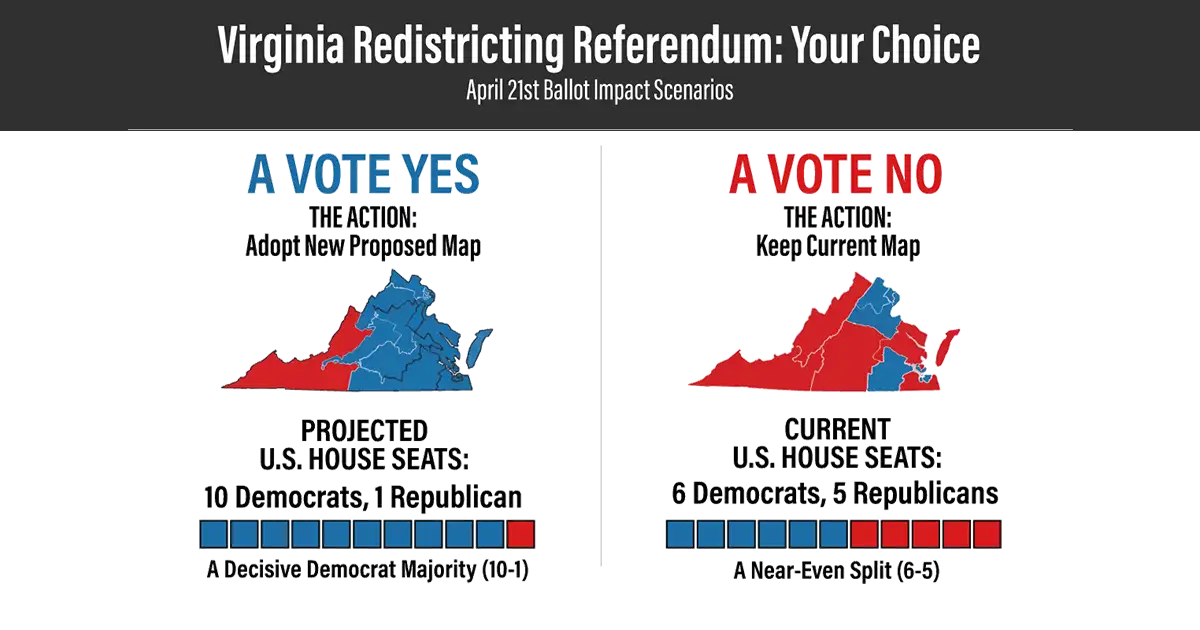
The Democrats’ plan is to redraw Virginia’s congressional districts mid-decade, but especially in time for this November’s mid-term elections, to alter the current alignment from six (6) Democrat and five (5) Republican seats into an inordinate imbalance of 10 Democrats to 1 Republican seat. Such a shift would undeniably marginalize nearly half of Virginians in a state that is roughly evenly balanced. It would give Democrats 91% control despite Republicans earning 46.6% of the vote for President Trump in 2024, 48.1% in 2022 House races, and Republican Governor Glenn Youngkin winning 50.5% in 2021.
Fifty percent of the votes would control 91% of the seats. Such a split has been rightly derided as the most aggressive redistricting proposal in the country. It would effectively marginalize Republicans and rural voters across the state while boosting Democrat chances of nationally winning majority control of Congress.
As drafted by Democrats, the proposal to amend the state’s constitution will ask voters to answer ‘yes’ or ‘no’ to the following question:
“Should the Constitution of Virginia be amended to allow the General Assembly to temporarily adopt new congressional districts to restore fairness in the upcoming elections, while ensuring Virginia’s standard redistricting process resumes for all future redistricting after the 2030 census?”
The “restore fairness” phrasing stands out as deliberately deceptive. Such ballot language violates Virginia’s constitution because it is misleading. In particular, language that the measure would “restore fairness” could have voters believing that voting against the question will impose something that is “unfair” or that the current constitutional amendment is “unfair.”

Under the Virginia constitution (which includes the 2020 amendment), district lines may only be redrawn by the bipartisan redistricting commission only once every 10 years following a nationwide census. But their proposed amendment would allow Democrats to redraw the lines themselves to create the lopsided 10-1 congressional district map in time to impact this November’s midterm elections.
Hand in hand with their proposed amendment, Democrats also put forward their version of a map corresponding to ten Democrat-leaning districts with only one Republican. Their map carves up conservative strongholds (e.g., the Shenandoah Valley, Southwest Virginia, and Hampton Roads) and would divide Republican voters into smaller groupings to place them amid more concentrated Democrat voter centers.
To widen their present advantage, Democrats have put forward their map configuration with deep blue urban Northern Virginia sliced into five narrow channels of voters that fan out into the rest of the state. The consequences of such a map would entail anomalies such as:
• Districts are drawn with “tendrils” to connect Democratic-leaning pockets, ignoring traditional county and city lines.
• Vote-rich Democratic areas in Fairfax and Prince William counties are sliced into parts of five different districts to maximize or dilute suburban voting blocs.
• The map consolidates most Republican voting strength into a single, highly concentrated 9th District in Southwest Virginia.
• A district devised to connect college towns — Radford, Blacksburg, Roanoke, Lexington, and Charlottesville — stretches north to include Harrisonburg, creating a heavily Democratic district cutting through the center of the state.
• Traditionally smaller blue cities like Danville are moved from surrounding rural districts into others to pad Democratic numbers.
Democrat supporters of the new amendment insist the redistricting dispute is merely an extension of national political battles dating back years. Such an argument misses the point. Whatever one’s views of present-day national politics and current events, Virginia voters previously spoke clearly and firmly to amend the state’s constitution to remove redistricting from potential partisan control by the party in power in Richmond at the time.
Finally, can anyone really believe Virginia Democrats would return to the state’s constitutional status quo of a nonpartisan redistricting commission after the 2030 U.S. census if they achieve their desired 10-1 supermajority?
A move by one party to gain a 10-1 advantage in congressional seats in a state where the voting public is nearly equally divided should objectively be viewed as patently “unfair” regardless of party affiliation and by any voter with an eye towards how that might play out for generations of Virginians to come.
How quickly they forget. It was just in 2020 Virginians voted statewide — by a decisive margin — to reject partisan and political gerrymandering and create an independent and nonpartisan redistricting commission and process that works outside the ebbs and flows of the day’s politics. That constitutional decision — for that matter, any constitutional amendment — should not be taken lightly or be easily swayed by whatever political winds are presently blowing.
The wisdom and foresight of voters shown across the political spectrum in 2020 will benefit all Virginians now and the future by holding fast to the constitutionally mandated structure and processes of a truly bipartisan commission working together to define the Commonwealth’s congressional boundaries.
Colonel Chris J. Krisinger, USAF (Ret) is a Virginia citizen and resident. He graduated from the United States Air Force Academy and served in policy advisory positions at the Pentagon and twice at the Department of State. He is a Distinguished Graduate of the Naval War College and was also a National Defense Fellow at Harvard University. Want to continue discussion: cjkrisinger@gmail.com.