
Virginia is the data center capital of the world, and the power bill is coming due.
Dominion’s own filing with the regional grid operator projects data-center peak demand in its Virginia zone reaching 13.3 gigawatts by 2038 — roughly five times the 2.8 gigawatts they drew in 2022. PJM expects the Dominion zone to post the largest absolute increase in summer peak demand of any zone it manages between 2026 and 2030.
State analysts at JLARC found that if data-center growth runs unconstrained, Virginia’s energy demand rises 183 percent by 2040.
Without that growth: 15 percent.
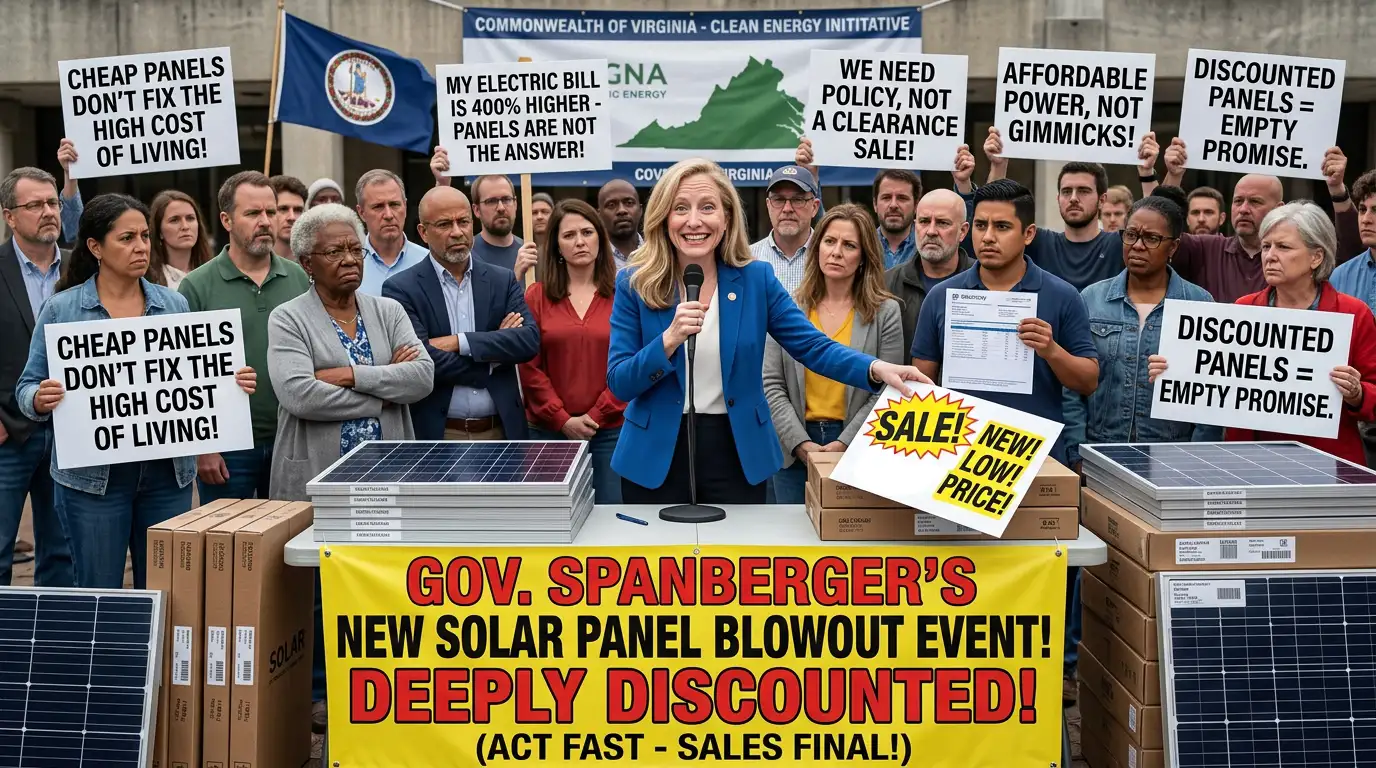
That is the gap. On Monday, Governor Abigail Spanberger announced how she intends to close it: a bulk-buying program for rooftop solar panels.
It’s called Switch Together. Homeowners sign up, installers bid against each other in a reverse auction, and the winners offer a discount — about 23 percent, roughly $6,300 off a typical system. The campaign runs through October 15. Her office calls it “first-in-the-nation.“
Read the fine print and you find the tell. The program “requires no direct expenditure of state funds.“ None. Not because the Governor found a clever efficiency, but because a coupon doesn’t cost anything. It generates no electricity. It builds no plant. It adds not one megawatt to a grid that needs thousands.
“We are taking real, practical action,“ Spanberger said, “to address high energy costs for Virginians, protect families from future rate hikes, and meet rising energy demand.“
Meet rising energy demand. With a group discount on panels. Against 13.3 gigawatts.
Here’s what’s actually happening to your bill. On November 25, the State Corporation Commission approved a Dominion base-rate increase delivering $565.7 million in additional revenue in 2026 and $209.9 million in 2027 — less than the $822 million and $345 million Dominion asked for, but an increase all the same. For the typical residential customer that’s $11.24 more a month this year and another $2.36 next year, on a bill that started around $150. That’s base rates alone, before fuel costs move.
Virginians have every right to be furious, and not about the panels. They’re furious because the serious answer is hard, slow, and expensive — which is exactly why a state facing a fivefold demand increase should have been building a decade ago.
Nuclear is that answer, and nobody should pretend it’s easy. Dominion is exploring a small modular reactor at North Anna with Amazon — a roughly 300-megawatt project, still at the memorandum stage. Only two SMR designs have been approved by the Nuclear Regulatory Commission. Only two SMRs are operating anywhere on earth, one floating in Russia and one in China. A Utah project collapsed when costs ballooned from $3 billion to more than $9 billion. Georgia’s two new reactors arrived years late at $30 billion, twice the estimate. No new nuclear facility has been built in this country in three decades.
And John Parsons, deputy director for research at MIT’s Center for Energy and Environmental Policy Research, says the quiet part out loud: SMRs will not be built in time to meet near-term data-center demand.
That’s the indictment. Not that Spanberger failed to snap her fingers and produce a reactor — nobody can. It’s that the hard thing needed a decade of lead time and political capital, Governor Glenn Youngkin had at least laid out an all-of-the-above plan built around it, and this administration’s contribution to the energy emergency, this summer, is a group discount that expires October 15.
Which brings us to the part of this story the Governor would rather you didn’t line up chronologically.
On May 28, Spanberger removed John Rocovich as rector of Virginia Tech’s Board of Visitors, citing the Code of Conduct for Commonwealth Appointees, the board’s own code of ethics, and state statutes requiring members to act in Virginia Tech’s best interests. Her office declined to say what he’d actually done. Rocovich refused to step down, calling the action “deeply offensive“ and “legally unsupported.“
In that same announcement — same day, same press release — she named his replacement: Ed Baine, executive vice president of utility operations and president of Dominion Energy Virginia.
Baine personally gave $5,000 to Spanberger’s 2025 campaign. Dominion Energy gave $100,000. Across the 2024–25 cycle, Dominion spread $19.3 million among campaigns in both parties.
You don’t have to take a Republican’s word for what that looks like. Clean Virginia — a watchdog group that spends most of its energy fighting Republicans — said it plainly. “Governor Spanberger says she removed rector Rocovich over ethical concerns,“ said executive director Brennan Gilmore. “But the person she chose to replace him has spent years at the top of a utility that has overcharged Virginia customers by billions of dollars and corrupted our political system.“
An ethics firing, filled the same afternoon by a donor from the monopoly whose rates are climbing. Six weeks later, that same Governor announces her big affordability idea, and it’s a solar coupon that asks Dominion for nothing.
Nothing about generation. Nothing about the 13.3 gigawatts. A discount, a deadline of October 15, and a press release with “first-in-the-nation“ in the headline.
Virginia governors cannot succeed themselves, so Spanberger won’t be on a ballot in 2029. The legislators who pass her energy agenda will be. Every seat in the House of Delegates and the State Senate is up on November 2, 2027.
Your bill will have gone up twice more by then. Remember who told you a coupon was a plan.