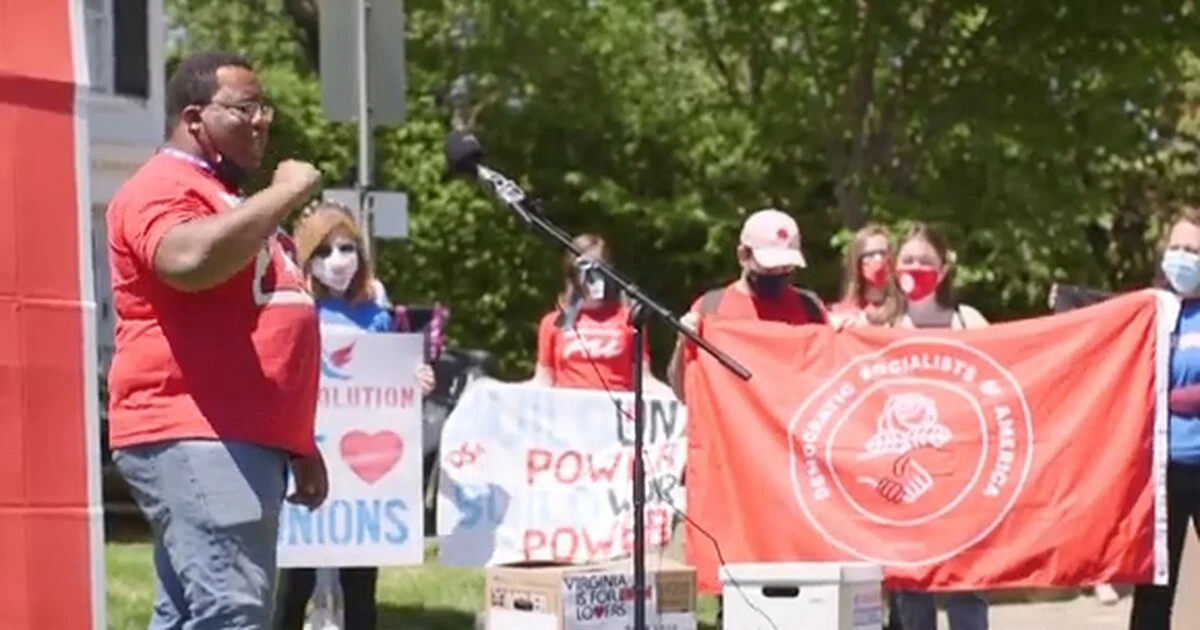
Metro DC DSA volunteers will knock on doors in Alexandria this Saturday, October 24, asking for a “Yes on All 3” on the three amendments on our ballot.
They’ll be in Leesburg on Sunday, then back in Alexandria the next weekend. The last push is Sunday, November 1, two days before the polls open.
Those are the same three YES votes the Fairfax Democrats’ voter site, fairfaxvotes.org, tells you to cast. And they’re the same three we’ve been asking our neighbors to vote NO on.
So let’s be clear about what November 3 is. One party already holds the governor’s office and both chambers, and nine of the ten seats on our Board of Supervisors.
That part is settled. What’s left for us to decide this year is on this ballot: three amendments, two bonds and our seats in Congress, plus local races in Herndon. The socialists are working the Democrats’ side of it.
Metro DC DSA, the local chapter of the Democratic Socialists of America, says on its own “about” page that capitalism “cannot be reformed into a just system.”
The same page says the most effective path to electing socialists runs through the Democrats’ ballot line.
Translation: why build a party when you can borrow one?
Their Northern Virginia branch covers Alexandria, Arlington and Fairfax County. Its priorities, in its own words: “defund the police, organize tenants, pass Medicare 4 ALL resolutions, unionize workers, and fight for migrant justice.”
In July the chapter wrote that DSA groups “from Richmond to Northern Virginia are mobilizing the growing democratic socialist electoral machine across the state” for Yes on All 3, and opened a fund to print literature and make merch.
Now look at what they didn’t do. Metro DC DSA’s 2026 endorsement list names no Virginia candidate at all, just the three amendments.
That’s the whole story in one line. The socialists skipped the candidates and went straight for the ballot questions. Those questions are the program, and the Fairfax Democrats are already out selling it.
Sen. Saddam Salim (D-SD-37) of Fairfax co-carried SB 531 with Sen. Kannan Srinivasan (D-SD-32), and Gov. Abigail Spanberger (D) signed it in April.
Starting July 1, 2027, every locality that hadn’t adopted its own ADU ordinance before January 1, 2026 must allow backyard homes in single-family neighborhoods.
The permit fee for the unit itself is capped at $500, though other fees can still apply. No “large setbacks,” and no rule that the person living out back be family.
One neighborhood coalition warned of “overdevelopment, overcrowding, traffic, and parking issues.”
Then the Faith in Housing Act. Spanberger signed it April 22, and from January 1, 2027, a property-tax-exempt church or qualifying nonprofit that has owned its land five years can build on it by right.
Local zoning has to allow at least 20 units an acre and buildings at least 45 feet tall. It can require no more than one parking space per unit, and 60 percent of the units must be affordable.
The Virginia Association of Counties, the counties’ own lobby, urged her to veto it.
Its words: the bills “override local decision-making authority,” and localities “shall not require a special exception, special use permit, conditional use permit, rezoning” or “any discretionary review or approval process.” She signed anyway.
Del. Dan Helmer (D-HD-10) of Fairfax carried a bill for by-right apartments and townhomes in commercial corridors, and it died this year.
Sen. Schuyler VanValkenburg (D-SD-16), who carried the Senate version, “plans to try again on the bill next year.”
Helmer and VanValkenburg also proposed “housing targets bills”: steps every locality would have to take to add housing, with the state stepping in if it didn’t, which critics called an “erosion of local control.”
And rent control. Sen. Jennifer Boysko (D-SD-38) carried SB 355, which would let localities cap rent increases. Under the bills, a locality could cap increases at 3 percent a year, add vacancy control and set up a local rent board.
Housing Commission staff called it among the strictest in the country. The Senate committee didn’t kill it; it “continued” the bill to 2027. It is waiting.
None of that happened by accident. One party wrote these bills. The governor signed the backyard-homes law and the church-lot law.
The corridor bill failed, and its sponsor says he’ll try again. The rent cap was pushed to 2027.
On Thursday, October 15, a federal appeals court revived the Fairfax and Arlington school boards’ lawsuits against the U.S. Education Department.
The fight is over policies that let students use the bathrooms and locker rooms “of their choosing.” The department had put both districts on “high-risk status,” meaning reimbursement-only.
A lower court had thrown the case out. FCPS appealed, and now says it is “encouraged” by the decision.
Read that again. Our School Board went to federal court to keep that policy, and it calls the ruling encouraging.
Meanwhile a Fairfax parent is suing the district. The lawsuit, as AFL summarizes it, alleges that FCPS Regulation 2603.3 “directs school staff to support and facilitate a student’s social ‘gender transition’ at school without notifying parents or obtaining their consent.”
It also says parents get no authority to overrule school “support plans.”
Then there’s the money. On Tuesday, October 13, Virginia Medicaid stopped covering transgender treatments for Virginians under 19 under a federal rule.
Spanberger said, “This is not a question of whether or not our administration is making a choice to pull back funds,” and her office is “looking at every option available.”
Her office says the money could come from the legislature, though the Mercury reports those conversations “have not yet started.”
Del. Laura Jane Cohen (D-HD-15) of Fairfax called the rule a “disaster.” She said “we’re going to try our best to make sure no Virginians lose their healthcare.”
Where does “the legislature” get money? From us. We wrote about this cut last week, and the hunt for “every option” is still on.
Ballotpedia says the 2026 session was the first time in five years that one party held the governor’s office and both chambers. Democrats hold the Senate 21-19 and the House of Delegates 64-36.
Supervisor Pat Herrity (R-Springfield) is “the 10-member body’s lone Republican” on a Board of Supervisors run by Chairman Jeff McKay (D-At Large). And in 2023, Democrats swept all 12 School Board seats and the county’s entire General Assembly delegation.
How did we get here? Simple. That November, their voters showed up, and Herrity was the only Republican left standing in the county.
As our ballot guide put it last month, “Democrats have run Fairfax and Richmond because their voters show up.” We said it then, and it still stings.
That 9-1 board can even change how we elect it. Nine Democrats hold the votes to switch Fairfax to ranked-choice voting, and state law does not require a public referendum first.
When one party holds everything, a no doesn’t count for much. Lawmakers stopped the corridor bill, and its sponsor says he’ll try again. The counties’ association asked for a veto of the church-lot law, and she signed it anyway.
Early voting runs through Saturday, October 31. The two Saturday sessions, 9 a.m. to 5 p.m., are October 24 and October 31.
Election Day is Tuesday, November 3, with polls open 6 a.m. to 7 p.m., and our guide has every location.
Our four: Bert Mizusawa (R) against Sen. Mark Warner (D) for U.S. Senate; Tony Sabio (R) against Rep. Don Beyer (D-VA-8); Dave Beckwith (R) against Rep. Suhas Subramanyam (D-VA-10); and Arthur Purves (R) against Rep. James Walkinshaw (D-VA-11).
Then NO on Question 1, NO on Question 2, and NO on Question 3. And NO on both county bonds, the $180 million parks bond and the $75 million community health and human services bond.
The socialists have their weekends planned through November 1. Ours are October 24 and October 31, and then Tuesday, November 3. Show up, and be the check.