
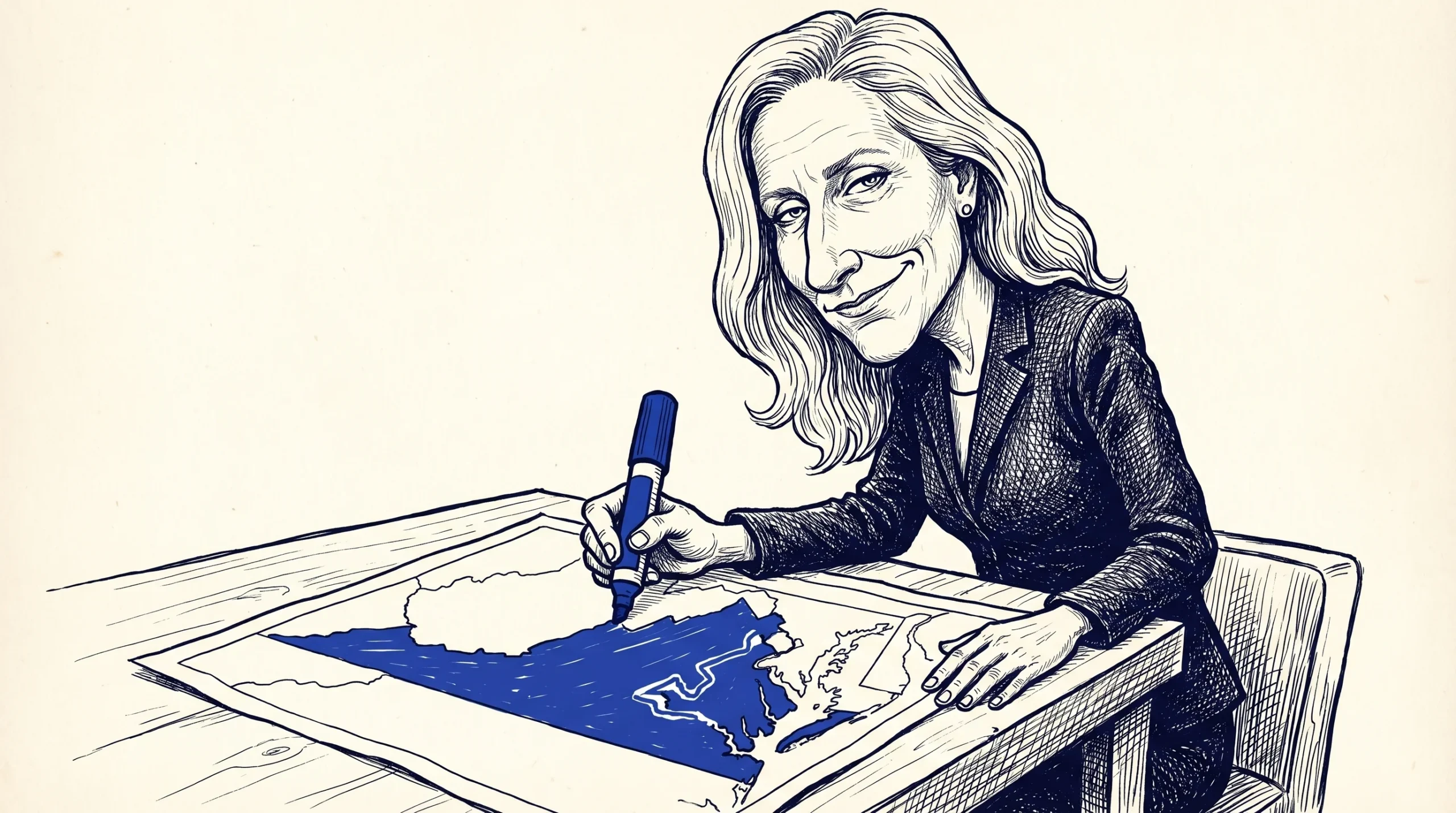
The redistricting amendment Democrats put on the April 21 ballot would have pushed Virginia’s U.S. House delegation from 6-5 to 10-1. On April 22, Tazewell County Circuit Judge Jack Hurley struck the referendum as “flagrantly misleading” — and AG Jay Jones (D) filed his appeal the same day. The Virginia Supreme Court heard oral arguments Monday, April 27. The case is now under advisement. The 10-1 outcome is one ruling away from being either restored or buried.
Eleven congressional seats. Ten Democrats. One Republican.
That is what Virginia’s U.S. House delegation — currently split 6-5 — was projected to look like under the redistricting amendment Democrats put on the April 21 ballot. The amendment passed both chambers of a General Assembly led by Senate Majority Leader Scott Surovell (D-Mt. Vernon) and House Speaker Don Scott (D). It then passed statewide 51.5% to 48.5%. A 3-point margin on a once-in-a-decade rewrite of the state’s political geography. The legislature wrote the amendment. The legislature would have controlled the process it created. Voters were asked to ratify what Richmond had already engineered.
It did not survive the day after.
On April 22, a Tazewell County Circuit Court judge struck the entire vote. Judge Jack Hurley ruled the referendum invalid because the ballot language submitted to voters “a flagrantly misleading question…and did not accurately describe” the constitutional change being proposed. Hurley declared the amendment “invalid from the start” — every vote ineffective.
AG Jay Jones (D) responded the same day. His first major statewide act since taking office in January was to attack the judge:
“Virginia voters have spoken, and an activist judge should not have the power over the People’s vote.”
That is the new attorney general — sworn to enforce the Constitution of Virginia — calling a Virginia judge an “activist” for finding that the ballot voters cast was not, in fact, the question they were asked. Jones filed an appeal to the Court of Appeals within hours.
The Virginia Supreme Court took the case Monday, April 27. Republican attorney Thomas R. McCarthy told the justices the proposed amendment was “invalid for several reasons, any one of which is sufficient to invalidate the proposed amendment and require invalidation of the vote.” On the process, McCarthy was sharper: “None of these voters had any idea this was coming. And that’s not how the process is supposed to work.” Justice Stephen McCullough said the case put the court “writing on a blank canvas.” The case is now under advisement. A ruling could come this week, this month, or later.
The “win” was no mandate. Fairfax delivered 69.5% YES — well above the statewide margin. Statewide, the margin was three points. Fairfax County Republican Committee Chair Katherine Gorka put it on the record: “That is not a resounding victory. 48.5% of Virginians believe this referendum was unfair, and in the long run, this will hurt Virginia.” RNC Chair Joe Gruters called the amendment “a blatant attempt to rig the system and lock in political power.”
The map remains the projection. Eleven seats. Ten Democrats. One Republican. The only remaining question is whether the Virginia Supreme Court restores the amendment that produced it, or buries it.
The Virginia Supreme Court is now under advisement. A ruling could land any day. AG Jay Jones faces voters November 6, 2029. Mark both moments down.
This is what the map fight looks like in Richmond. The Democrat majority that engineered the 10-1 amendment is the same operation Fairfax conservatives have to outwork between now and November. Donate to the Fairfax County Republican Committee so the campaign that contests every one of those engineered seats has Fairfax money behind it — not the leftover crumbs of whatever Richmond and out-of-state Democrat PACs spent first. The Virginia Supreme Court is deciding the map’s fate any day. The midterms are six months away. Every dollar raised in April, May, and June becomes voter contact in October. Match your donation with a neighbor’s. Forward this to the Fairfax conservative who keeps asking what they can actually do.