
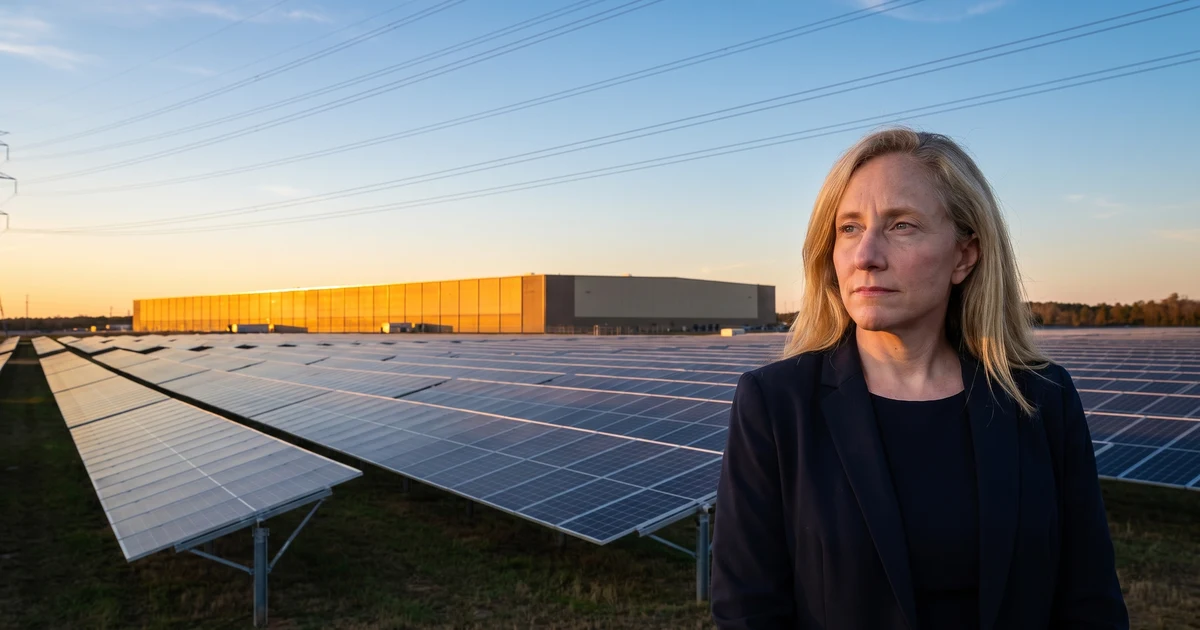
Picture Fairfax County, Arlington and Alexandria with every acre under solar panels. That is the solar footprint in the energy path Gov. Abigail Spanberger (D) said her team favors. The plan’s table puts it at 277,000 acres in its Distributed Flexibility scenario. 7News did the math: “That’s the size of Fairfax County, Arlington County, and the City of Alexandria combined.” Virginia has about 30,000 acres of solar today.
That is a modeled figure, and it assumes all new solar goes on greenfield sites at the historical rate of forest and farmland displacement. The plan’s other scenarios come in lower, at 233,000 acres under Current Policies and 185,000 under a Moderate Solar case, but even the smallest is six times what Virginia has today.
Why would a plan model new solar worth nine times what Virginia has now? In the Committee’s view, data centers. Cardinal News reports they are “the largest driver of rising electricity demand.” Sen. Glen Sturtevant (R-Chesterfield) read the plan, released Oct. 1, and called it “more of a data center growth plan that’s wrapped up in environmentally friendly packaging.”
Her own party said it first. Back in June, Senate President Pro Tempore L. Louise Lucas (D-Portsmouth) was fighting the Governor over a sales tax break for data centers, and Lucas hung a name on her:
Amazon Don and Data Center Diva, you are making a MONUMENTAL MISTAKE! Maybe you should ask Glenn Youngkin how that worked out for him!
— L. Louise Lucas (@SenLouiseLucas) June 5, 2026
Asked about the nickname by 7News, Lucas said: “Data center, she’s a diva.” At the time, the Governor was fighting to preserve the data center tax break, which Lucas put at “~$2 billion a year.”
In the Committee’s view, the energy plan is the proof. The plan’s table does not assign its acreage to data centers, but its path could take a quarter-million acres in a state where data centers are the biggest driver of demand, and the Committee reads the one as the cost of the other. By the plan’s own numbers, that land has mostly come from forest and farmland: half of utility solar so far went on forested land and 40 percent on farms.
The Governor herself does not claim the panels are enough. Two weeks before the plan came out, she told 7News that “solar alone is certainly not going to meet the need.”
Ratepayers are not starting from zero, and the increase below was approved before this plan. The Committee reported last week on the carbon-permit charge headed for Dominion bills. And last year regulators raised the average Dominion home bill by $13.60 a month over two years, with the first $11.24 taking effect on Jan. 1. In the Committee’s view, any new cost from this plan lands on a bill that is already climbing.
The state’s own watchdog, JLARC, saw this coming in 2024. It found that data centers will likely raise costs for all customers. A typical Dominion home could pay $14 to $37 more a month by 2040, in today’s dollars.
The Governor sells her path as the lowest cost. Look at the math. The plan puts its system cost at $385 billion through 2050, against $295 billion in its No Policy case. Those are statewide system costs, not household bills. Her path only wins after the plan adds a “social cost of carbon” and health costs on top.
House Minority Leader Terry Kilgore (R-Scott County) put it this way: the plan “only becomes the ‘affordable’ option when it includes ‘social costs,’ something that doesn’t show up on power bills.” In the Committee’s view, that is the gap: the plan’s case for the lowest cost rests on statewide modeled costs, and neither the plan nor Kilgore’s statement calculates what a household would pay under it.
The plan says data centers should pay for the grid they need. Good. Who makes them? In August, regulators ordered Dominion to develop a policy that assigns the cost of power lines built for data centers to those data centers. That order tells Dominion to draw up the policy. It does not finish the job.
The plan admits regulators did not change the cost split last November, that “broader allocation of shared generation and transmission costs remains subject to future SCC proceedings,” and that depending on the formula, households could carry 37 to 51 percent of the system’s costs. The Governor’s office also says the plan “does not set electric rates or approve projects.” In the Committee’s view, that means the promise that data centers will pay sits in a document that cannot make them.
In the Committee’s view, the Governor owes Fairfax ratepayers two numbers before she asks for the land: what a typical household pays, and what a data center pays. She says she is drafting bills for the session that starts in January. Until she names them, the Data Center Diva’s plan is a promise on paper, and the only number anyone can count on is the one at the bottom of your Dominion bill.