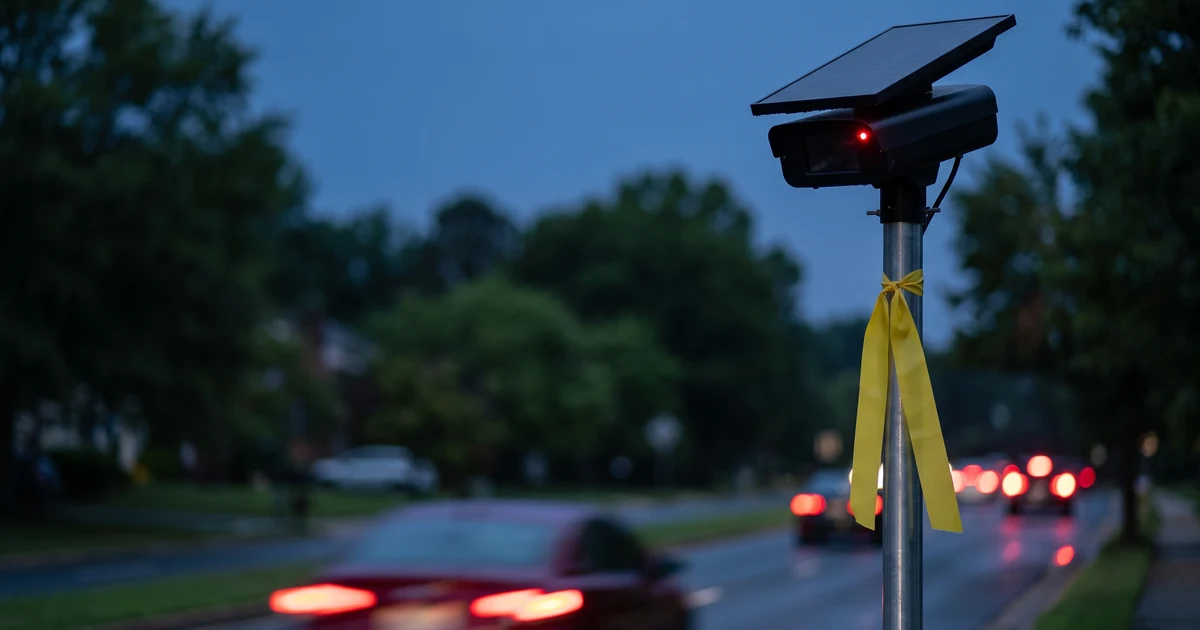
In November 2022, the Fairfax County Police Department began using automated license plate reader technology from three vendors: Axon, Flock Safety, and Motorola. The cameras photograph passing vehicles, read their plates, and check them against lists of stolen cars, wanted persons, and missing people. Today FCPD runs two kinds of systems. There are 712 Axon plate readers mounted on most police cruisers, and 84 fixed Flock cameras installed around the county. All of it feeds FCPD’s Real Time Crime Center, which also draws on drones and other camera systems.
The department reports real results. From November 2022 through early September 2026, plate reader technology contributed to 1,594 cases, 555 recovered stolen vehicles, 912 arrests, 66 recovered guns, and 57 missing persons located.
In 2025, Virginia put strict rules around all of it. A bipartisan law now requires plate data to be purged after 21 days, limits searches to criminal investigations and missing-person cases, and requires internal audits every 30 days. It bars sharing data with federal or out-of-state databases except through narrow channels such as court orders, and requires annual public reporting. Willful misuse is a Class 1 misdemeanor, and evidence gathered in violation of the law cannot be used in court.
Then came a national backlash against Flock specifically, driven by reports of officer misuse in other states and fears about who can reach the company’s nationwide network. According to the Institute for Justice, more than 200 local governments have canceled or declined to renew plate reader contracts since the start of 2025. In Northern Virginia, the backlash moved fast. On September 15, Arlington voted to remove its 41 county-leased Flock cameras. Alexandria Mayor Alyia Gaskins has said she sees no role for Flock in her city, which is reviewing its contract. The same day as Arlington’s vote, after hundreds of resident emails, the Fairfax Board of Supervisors voted unanimously to pause new Flock installations until its Safety and Security Committee reviews the program on October 20.
Look at what the pause actually does. County officials said no new Flock installations were scheduled before October 20 anyway. The 84 existing Flock cameras stay on. The 712 cruiser-mounted plate readers are unaffected. And no Flock cameras currently sit on school grounds, so the School Board’s vote on banning future installations there is preventive.
At the same meeting where he moved the pause, Chairman Jeff McKay called plate reader technology a clear public safety benefit and said FCPD’s policies keep it limited to legitimate law enforcement purposes. If both of those things are true, residents deserve to hear what specific problem the pause is meant to solve. A freeze on installations nobody planned looks less like policy than like a way to show a flood of emails that the board heard them.
That matters because much of the campaign behind those emails rests on claims FCPD has publicly disputed. When a news article cited two FCPD searches as evidence of immigration enforcement, the department answered that one was a financial fraud investigation conducted with the Department of Homeland Security and the other was the investigation of a Homeland Security vehicle deliberately set on fire in Virginia. FCPD states plainly that plate data is not used for immigration enforcement, and that federal agencies and agencies outside Virginia cannot access it without a court order.
Supervisors disagree about where this goes. Dranesville Supervisor Jimmy Bierman suggested the pause could be the beginning of the end for Flock. Other board members said they want a balanced review of the technology’s costs and benefits. Residents should hold the board to the second approach: judge the program on facts, not on volume of email.
Concern about license plate surveillance is not new, and it has never belonged to one party. But Republicans have been part of it from the start in Virginia.
In 2013, Republican Attorney General Ken Cuccinelli issued an opinion questioning whether police could passively collect and store plate data on drivers who were not suspected of anything. Two years later, the ACLU of Virginia sued Fairfax County over its plate reader database. The protections now in state law passed in 2025 with support from both parties.
Nationally, several prominent Republicans have recently pushed for tighter limits. On August 27, Texas Gov. Greg Abbott stopped state agencies from spending state funds on Flock cameras while the technology is reviewed. Days later, Florida Gov. Ron DeSantis’s administration ordered plate reader cameras removed from rights-of-way on the state highway system. In Congress, Tennessee Rep. Tim Burchett has proposed broad federal limits on plate reader surveillance, and Texas Rep. Keith Self’s PRIVACY Act would require federal agencies to get a warrant before searching state and local surveillance databases.
The conservative argument is straightforward. Many conservatives argue that a searchable database able to reconstruct where law-abiding people drive raises serious Fourth Amendment concerns, especially as networks grow and connect to one another. That concern can coexist with support for police. The point is to keep a useful tool pointed at criminals and away from everyone else.
Virginia law already sets a strong baseline, so the October review should focus on what that baseline leaves out:
The Board’s Safety and Security Committee meets Tuesday, October 20, at 1:30 p.m. to continue its review of the Flock program. Contact your supervisor before then. Tell them you want decisions based on facts and the Constitution: a warrant requirement, transparent results, and accountability. Don’t settle for a symbolic pause, and don’t let the loudest campaign decide the future of a tool that helps find stolen cars and missing people.