
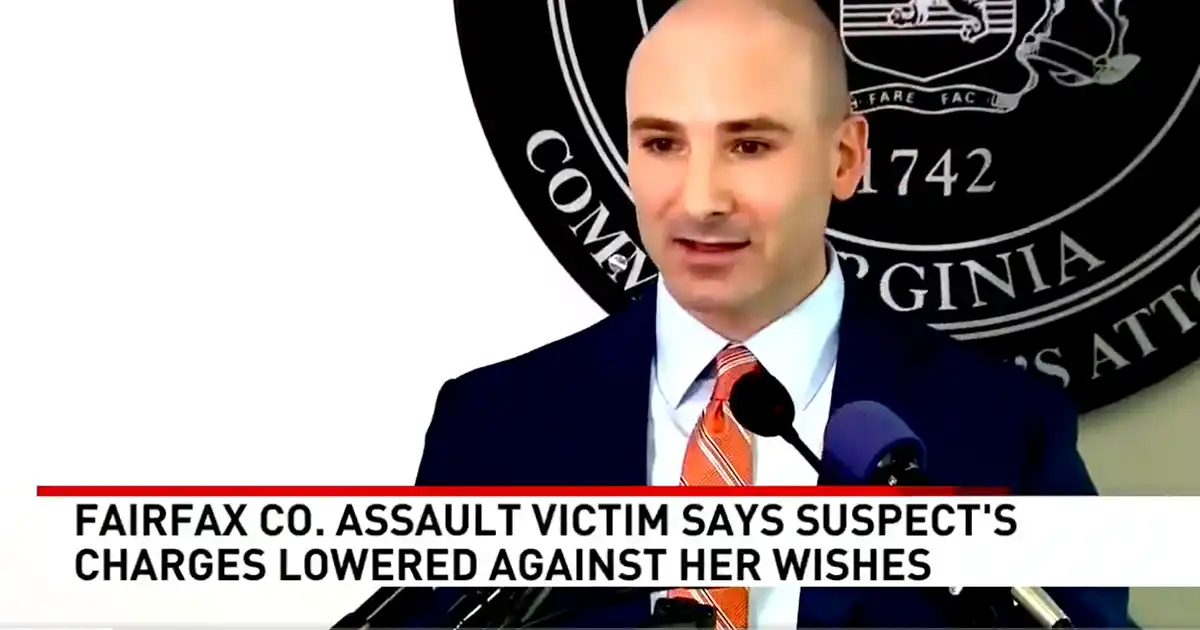
In ten days, three separate developments put Fairfax Commonwealth’s Attorney Steve Descano back at the center of the debate over crime, immigration enforcement, and accountability.
First, a murdered woman’s mother launched an effort to remove him from office.
Cheryl Minter’s daughter Stephanie was stabbed to death at a Fairfax County bus stop on February 23, 2026. On August 27, Minter launched a petition to remove Descano. It quickly surpassed 12,000 online signatures.
Second, Congress gave Descano a deadline.
House Judiciary Chairman Jim Jordan and Immigration Subcommittee Chairman Tom McClintock have demanded records concerning Descano’s prosecution policies toward non-citizens. On August 24, they gave him until 5:00 p.m. September 7, 2026 to produce the outstanding documents or face possible compulsory process — a subpoena.
Third, a federal judge blocked much of Virginia’s new law restricting local cooperation with ICE.
On September 1, Senior U.S. District Judge Robert Payne issued a preliminary injunction against major portions of SB 783/HB 1441, legislation Gov. Abigail Spanberger signed in April. Attorney General Jay Jones immediately vowed to appeal.
These fights are connected by one larger question:
Have Fairfax and Virginia officials allowed ideology to take priority over public safety?
Descano’s office openly considers immigration consequences when making charging and plea decisions. His campaign has defended that policy by arguing that two people who commit the same offense should not face dramatically different consequences simply because one could be deported.
His critics say the results of that philosophy are now impossible to ignore.
As of August 19, four of the eight suspects in Fairfax County’s 2026 homicide cases were reportedly in the country illegally.
And the individual cases are difficult to dismiss.
Stephanie Minter was a single mother waiting at a Fairfax County bus stop when she was killed.
The man charged with murdering her, Abdul Jalloh, had accumulated more than 30 prior arrests in Fairfax County, including rape and assault allegations. Many of the charges were dropped.
Police had repeatedly warned prosecutors about him.
One police email said it was:
“not a question of if, but rather when he will maliciously wound (or worse) again.”
Jalloh is now awaiting trial for Stephanie Minter’s murder in January 2027.
Her mother has testified before Congress, filed a civil-rights complaint that helped trigger a Justice Department investigation, and is now trying to remove Descano from office.
But there is an important distinction.
An online petition is not a recall.
Virginia’s removal process requires signatures equal to 10 percent of the votes cast in Descano’s last election — more than 29,000 qualified Fairfax County voters — before a court can determine whether the statutory grounds for removal have been met.
It is a steep hill.
It is also why the political question matters just as much as the legal one.
Since January, the House Judiciary Committee has sought records about Descano’s prosecution of non-citizens, including written policies and documents showing whether immigration consequences affected charging and plea decisions.
Descano testified before Congress in May but has not produced everything the Committee requested.
So Jordan and McClintock gave him a deadline:
5:00 p.m. September 7.
If he does not comply, the Committee says it will consider compulsory process.
Descano argues Congress has no authority to second-guess a local prosecutor’s discretionary decisions.
The Committee argues that its oversight authority extends to questions involving federal immigration law.
The Justice Department is separately investigating whether Descano’s office provided preferential treatment to defendants in the country illegally.
That investigation began after a civil-rights complaint filed on Cheryl Minter’s behalf.
Fairfax’s policies do not exist in isolation.
Gov. Abigail Spanberger has rescinded the previous administration’s ICE cooperation order, directed state agencies to terminate 287(g) partnerships, signed legislation imposing new restrictions on local ICE agreements, and restricted immigration enforcement access to state property.
The Justice Department sued.
On September 1, Judge Robert Payne blocked most of the new law while the litigation proceeds.
Attorney General Jay Jones said Virginia will seek a stay and appeal.
The legal fight will continue.
But while Richmond and Washington argue over immigration policy, Fairfax voters have something more concrete to examine:
the cases.
Marvin Morales-Ortez, a Salvadoran national in the country illegally and alleged MS-13 member, repeatedly passed through Fairfax County’s criminal justice system.
In one murder case, Descano’s prosecutors argued in court that Morales-Ortez had admitted being present for the killing and striking the victim three times with a machete.
The murder charge was later dropped after prosecutors concluded he was not the perpetrator.
Other robbery, weapons, assault, and malicious-wounding charges were also dropped.
Morales-Ortez was released from custody on December 16, 2025.
The next day, he allegedly murdered his roommate in Reston.
The Department of Homeland Security responded by accusing Fairfax’s sanctuary-policy supporters of having “blood on their hands.”
Sheriff Stacey Kincaid’s office said ICE had been notified but had not obtained the judicial warrant required under the Sheriff’s policy to hold him beyond his release date.
Wilmer Osmany Ramos Girón, a Guatemalan national previously deported twice, was charged with felony abduction by force, felony strangulation, and assault.
He ultimately pleaded guilty to two misdemeanors — simple assault and brandishing a blade — and served roughly two months.
Descano’s office said the resolution was based primarily on the victim’s wishes.
The victim publicly disputed that account.
She told 7News she expected Ramos Girón to receive a substantial prison sentence, wanted him incarcerated for at least a year, and objected when prosecutors proposed far less.
ICE later arrested him.
In another Fairfax case, Maldin Anibal Guzman and Wis Alonso Sorto-Portillo pleaded guilty in connection with a 2024 murder.
They faced sentences of up to 40 years.
They received five.
Descano’s office said the case had serious evidentiary problems: no DNA or physical evidence at the scene and witnesses afraid to testify. Prosecutors argued the plea was the only reliable way to ensure both defendants went to prison.
That is a legitimate argument.
Voters can decide whether five years was a legitimate outcome.
Other cases cited by federal officials and congressional investigators involve defendants accused of child sexual offenses, aggravated sexual battery, abduction, burglary, and other serious crimes whose charges were dismissed, reduced, or followed by release despite ICE detainers.
Any one case can involve weak evidence, reluctant witnesses, constitutional limitations, or difficult prosecutorial judgments.
The criticism of Descano is not that prosecutors sometimes lose cases.
It is that the same type of outcome keeps appearing.
Serious charges dismissed.
Felonies reduced dramatically.
Defendants released despite federal immigration interest.
Victims publicly questioning the prosecutor’s explanation.
And an office whose written policy explicitly directs prosecutors to consider immigration consequences.
At some point, voters have to decide whether they are looking at isolated cases or the predictable results of a governing philosophy.
Descano does not operate alone.
Steve Descano (D) is Commonwealth’s Attorney and controls prosecution policy.
Sheriff Stacey Kincaid (D) oversees the jail and its policies governing immigration detainers.
Chairman Jeff McKay and the Fairfax County Board of Supervisors shape Fairfax County’s broader approach to immigration enforcement.
Gov. Abigail Spanberger and Attorney General Jay Jones are defending Virginia’s restrictions on cooperation with federal immigration authorities.
Voters will have opportunities to judge all of them.
But there is one fact Fairfax Republicans should confront themselves.
In November 2023, Steve Descano’s name was the only one on the general-election ballot for Commonwealth’s Attorney.
Republicans did not field a candidate.
Defense attorney Ed Nuttall mounted a write-in campaign after losing the Democratic primary, but there was no traditional challenger on the ballot.
That should not happen again.
Whatever Fairfax voters think about Descano, an elected prosecutor should have to defend his record in a competitive election.
And getting someone onto the ballot is not an impossible task.
Virginia requires just 125 qualified-voter petition signatures for a Commonwealth’s Attorney candidate.
The next election is November 2027.
Petitions can begin circulating January 1 of the election year, with filing due in June.
That means the real work begins long before Election Day.
Fairfax County has thousands of attorneys: prosecutors, defense lawyers, former JAGs, federal attorneys, county attorneys, and lawyers who have spent years watching this justice system operate.
One of them should run.
And everyone who is not a lawyer can help find that person, organize petitions, raise money, knock doors, recruit volunteers, and build the campaign.
The lesson of 2023 should be obvious:
Being angry at an elected official does not matter if voters are never given another name to vote for.
Cheryl Minter decided to fight after losing her daughter.
Congress is demanding answers.
The Justice Department is investigating.
A federal judge has now intervened in Virginia’s broader immigration-policy fight.
But ultimately, Fairfax voters have the simplest tool of all.
Put someone else on the ballot.