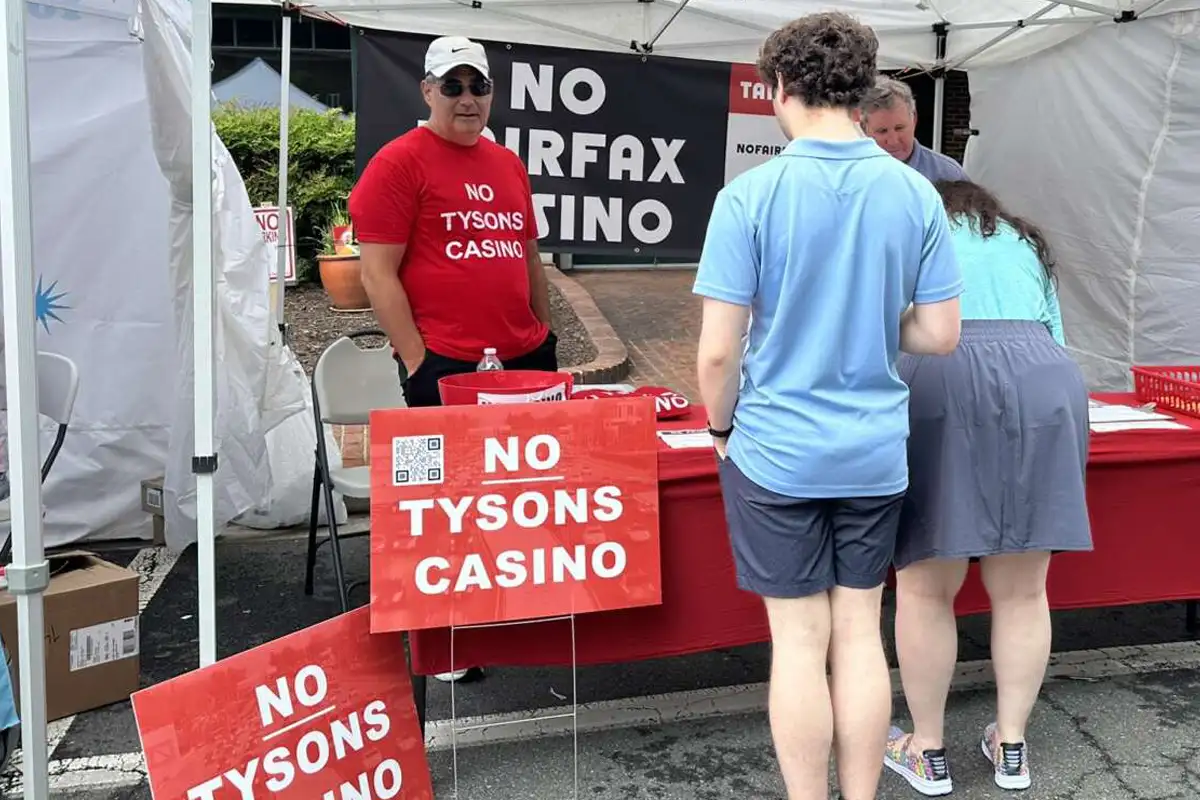
The Fairfax County Board of Supervisors just held another casino vote—and somehow managed to make things even more confusing. After a narrow 5-4 decision that their own Board Chairman Jeff McKay called “political opportunism,” the county still hasn’t clearly said yes or no to a casino.
Here’s the problem: Democrat State Senator Scott Surovell (34th District), who serves as Virginia Senate Majority Leader, has already announced he’s bringing back casino legislation in January. He’s pushing for a gambling facility near Tysons despite poll after poll showing strong opposition from Fairfax County residents. Why? Because Democrat politicians in Richmond want the tax revenue—and they’re willing to override local residents to get it.
Meanwhile, on the Board of Supervisors, Democrats are fighting amongst themselves. Hunter Mill Supervisor Walter Alcorn pushed through a last-minute amendment opposing casino legislation, but Chairman McKay warned it could “backfire” and make the county look arrogant to Richmond lawmakers. Providence Supervisor Dalia Palchik called the whole process “unprecedented” and said she was “extremely disappointed” with how it was handled.
This is what one-party Democrat rule looks like: confusion, infighting, and backdoor deals in Richmond. Senator Surovell is openly pushing a casino that his own constituents oppose, while Board Supervisors can’t even agree on a strategy.
Common-sense Virginians deserve leaders who listen to their concerns—not politicians who play games with major land-use decisions while taking their cues from Richmond insiders.
Contact your County Supervisor and State Senator and demand they put residents first—not casino developers and Richmond power brokers.
By Scott McCaffrey and Angela Woolsey Published in FFXNow on December 9, 2025
By the narrowest of majorities, the Fairfax County Board of Supervisors went on record today (Tuesday) opposing any state legislation authorizing development of a casino property within the county’s borders.
The 5-4 vote was in support of a proposal from Hunter Mill District Supervisor Walter Alcorn to include a plank in the county’s 2026 legislative package stating opposition to any casino legislation until it is formally requested by a majority of supervisors and meets a number of other criteria.
Alcorn said even the possibility of a casino in the Tysons area could have a “chilling effect” on economic development there, based on his conversations with property owners and developers.
“They’re worried” about negative impacts a casino could bring, he said.
It was a view that resonated with Franconia District Supervisor Rodney Lusk.
“Tysons is the number-one business center in the commonwealth,” he said. “How do we ensure we’re not creating an issue?”
Alcorn, Lusk, Providence District Supervisor Dalia Palchik, Dranesville District Supervisor Jimmy Bierman and Board Chair Jeff McKay supported adding a blanket statement of opposition to a casino to the county’s legislative priorities for the Virginia General Assembly’s 2026 session.
Mason District Supervisor Andres Jimenez, Sully District Supervisor Kathy Smith, Mount Vernon District Supervisor Dan Stork and Springfield District Supervisor Pat Herrity opposed the amendment.
The 10th spot on the board remains vacant, pending the outcome of today’s special election to fill the Braddock District seat left vacant when James Walkinshaw was elected to Congress.
The full text of Alcorn’s amendment reads:
“Oppose legislation in the General Assembly that authorizes a casino in Fairfax County without any request for such legislation from the Board of Supervisors, without implementation of a statewide Gaming Commission, and without a tax revenue split that substantially benefits Fairfax County as opposed to the commonwealth. The designation and location of a casino is inherently a major land-use decision, and General Assembly intervention in Fairfax County’s land-use processes would undermine decades of community consensus and economic success.”
McKay and Palchik supported the amendment despite voicing strong concerns about Alcorn’s proposal arriving at the last minute and not getting vetted during meetings of the board’s legislative committee.
McKay went so far as to call it “a moment of political opportunism” that could backfire on the county in Richmond.
Going Alcorn’s route could prove to be “a huge strategic mistake,” the Board chair said.
“I don’t think it will likely change a vote [in Richmond],” he said.
If anything, McKay said, it could convince downstate legislators to support the option of a casino in Tysons, with opposition by the Board of Supervisors being seen “by a lot of people as Fairfax County arrogance.”
Palchik, whose district represents 90% of Tysons, said she supported the intent of Alcorn’s measure, but like McKay, she criticized the way it was proposed.
“It’s unprecedented,” Palchik said. “I’m extremely disappointed.”

Bierman, however, said Alcorn’s proposal represents the views of county residents in opposing placement of a casino in the county.
“My constituents have been very, very clear” in their opposition to moving forward, he said, predicting that Fairfax County voters would reject a casino development if the matter ever gets approved by Richmond and goes to a referendum.
Bierman criticized “backroom deals” in Richmond that were “offensive to the people of Fairfax County.”
Herrity, the Board’s lone Republican, said he might end up opposed to a casino plan, but wasn’t ready to rule it out at the moment.
“We shouldn’t take that option off the table,” he said. “There are clearly a lot of pros and cons.”
Herrity said he had reached out to elected leaders in communities with casinos to get their input.
“I’ve seen it done right and I’ve seen it done wrong,” he said of integrating a casino into the broader community.
The vote on Alcorn’s proposal came after supervisors voted 9-0 to include a letter about the casino issue in the legislative package.
The letter “strengthens some of the language” used by the county in the past two legislative sessions, said McKay, who penned the message to General Assembly leaders.
His letter was “a comprehensive reaction” to the casino topic, the board chair said.
“You can’t just have a position. You have to have a strategy,” he said.

McKay’s letter, which remains in the legislative package despite the subsequent passage of Alcorn’s amendment, demands that any legislation on the issue have a referendum component; that the Board of Supervisors be the one to determine if and when to hold a referendum; and that a state gaming commission be set up before the matter go to voters.
It also reiterates past skepticism that a casino would be a “good financial deal” for county residents, based on the current share of revenue that goes to the state versus localities, noting that no independent analysis has been conducted for an establishment specifically in Fairfax.
Senate majority leader confirms casino bill will return
Legislation proposed in Richmond in recent years would add Fairfax County to the list of localities where a casino could be located.
To date, the measures have failed, but Senate Majority Leader Scott Surovell (D-34) confirmed to FFXnow in an interview before Thanksgiving that he will again sponsor a bill to make Fairfax County eligible for a casino in the 2026 session, which begins next month.
“Some version of it will be introduced,” Surovell said.
Surovell, whose district encompasses southeastern Fairfax County, maintains that a casino needs to be considered as an option for revenue at a time when the county’s commercial tax base is declining, primarily due to a sluggish office market.
“The county’s commercial tax base is continuing to crumble, and the county is going to have an incredibly difficult time sustaining teacher, police and firefighter salaries and our school services at existing levels, unless the county gets a major infusion of revenue in the next five years,” he said. “I think authorizing an entertainment district in the county is the surest way to do that.”
Though Surovell agrees a state gaming commission “needs to be explored,” he argues it should be “discussed together” with a bill on a Fairfax County casino and other gambling-related legislation.
“I’m sure the incumbent casinos in the state would love to have their licenses locked in before Fairfax County can receive the same benefits that other localities are currently enjoying, but I don’t think that’s fair to Fairfax County,” Surovell said.
The casino issue has divided Northern Virginia legislators as well as those from across the commonwealth.
State Sen. Jennifer Boysko (D-38), who represents Reston, Herndon, Great Falls and McLean, told FFXnow by email that she has “not changed my position of strong opposition to the proposal.”
“In poll after poll, as well as feedback I regularly receive in my community, there continues to be overwhelmingly strong opposition among voters, especially in Dranesville and Hunter Mill, communities I represent,” Boysko said.
“Rarely has there been a more unifying issue bringing Democrats, Republicans and independent voters together,” she said, adding:
“There are so many other urgent issues that the General Assembly must address around affordability, education, healthcare, transportation and changes in federal funding. I look forward to addressing the real issues facing our voters and to a productive 2026 session focusing on the needs and priorities of the people of our commonwealth.”
A bill proposed in the 2025 legislative session by Surovell limited the location of a casino to an area no further than a quarter mile from a Metro Silver Line station and within two miles of a regional enclosed mall.
It also would have to be part of a mixed-use development, such as the type proposed by a consortium led by Comstock that has lobbied for the casino bill in recent legislative sessions.
Past incarnations of the bill have not specified a specific site or designated a developer, which would be determined only after a referendum on the concept of a Fairfax casino is conducted.
In his letter to the General Assembly, McKay argued that the inclusion of specific criteria restricting possible locations for a casino site within the county circumvents local leaders’ authority to make land use decisions.
“[General Assembly intervention into our land use process would undermine a fundamental local government responsibility to work directly with the community to responsibly manage economic growth — something we do very well in Fairfax County,” McKay wrote.
In a statement shared with FFXnow this afternoon, McKay said he was “glad” that the other supervisors approved his letter to state lawmakers and stressed that his goal is to ensure any legislation includes “the necessary protections for our community”:
“These include a required voter referendum, a significantly better financial deal for the county, and maintaining local land use authority. Without these elements the Board would not support any casino. Folks have pushed for the Board to simply be either in favor of or against a casino, however, the issue is far more nuanced. We are not happy that casino proposals are created in a vacuum in Richmond far away from those most impacted. In other jurisdictions where casinos have been authorized localities were part of the conversations from their onset, not during or after legislation was filed. Our Board feels this is backwards – and have felt that way for years.”