
By Jared Serre in FFXNow and published December 2, 2025
Long plagued by personnel issues, the Fairfax County Sheriff’s Office (FCSO) is seeing an unsustainable trajectory of staff turnover — one that staff says demands the immediate attention of lawmakers.
Covid-era initiatives that were once expected to be temporary have become permanent, but only out of necessity, three staffers told a Fairfax County Board of Supervisors committee last week.
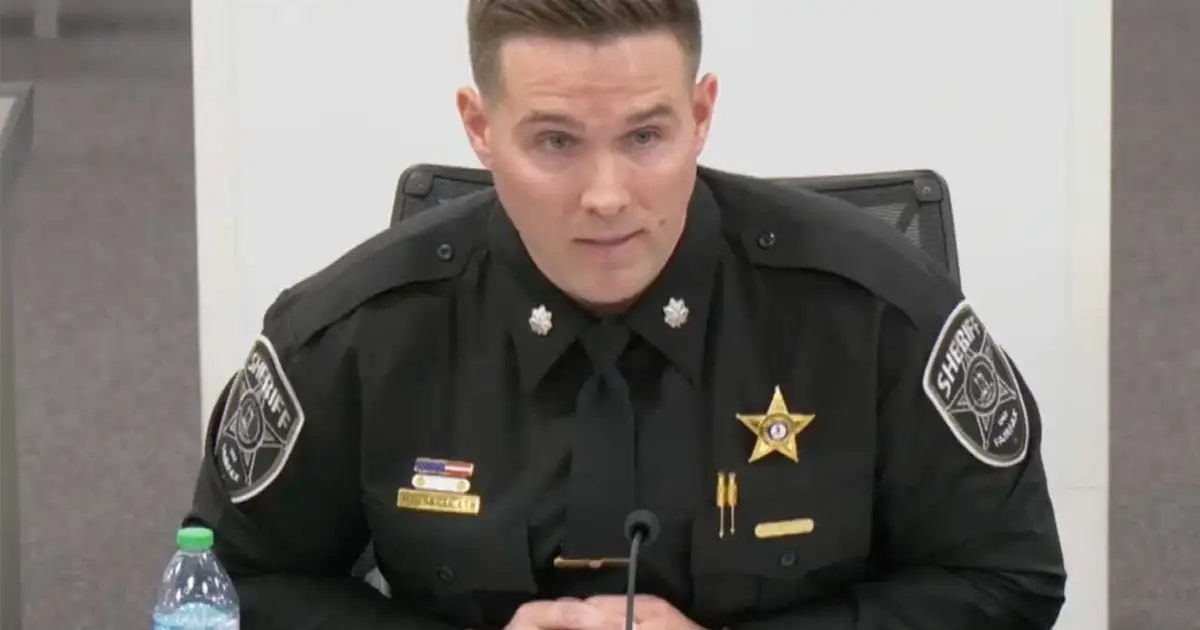
“We are not the same Sheriff’s Office that we were four, five years ago,” Lt. Col. Nick Andariese said at the Safety and Security Committee meeting on Nov. 25. “But that doesn’t mean we don’t want to get back to doing those things.”
Andariese, who is the FCSO’s chief deputy sheriff for operations, emphasized how mandatory overtime — installed in Jan. 2023 to combat staffing shortages — has skyrocketed, jumping to a projected 79,000 hours for 2025 compared to roughly 33,000 only four years ago.
The current arrangement has placed “a burden on our staff and our retention,” in addition to consuming an increasing percentage of the FCSO budget, Andariese said.
“We are clearly doing more with less and paying a lot more to staff fewer deputies,” he said. “The trajectory is unsustainable.”
The challenges facing the sheriff’s office have also extended into the judiciary, with FCSO deputies providing security for the Fairfax County Courthouse and operating the Adult Detention Center.
Among the biggest losses is an alternative sentencing branch, which was cut due to a lack of staffing. Judges can no longer order, and prosecutors can no longer offer, work release or weekend arrangements for inmates.
“There are a lot of sentencing alternatives that were lost with this,” Lt. Col. Casey Lingan, who leads FCSO’s administration efforts, said. “It’s kind of an unintended consequence, but it’s directly related to our staffing.”
Within the detention center, an increasing ratio of inmates to officers has triggered an increase in lockdowns. Access to programs and recreational activities has also been negatively impacted, potentially hindering rehabilitation efforts.
“As we face fatigue and burnout amongst our staff, and the stressors of increased lockdowns, we’re creating a pressure cooker environment,” Andariese said. “Our staff experience that burnout and fatigue while the inmate population becomes increasingly frustrated, and that’s an extremely dangerous mix for the safety and security of the facility.”
The increased tension has been cited as one driving factor for employees leaving the office, with more than half (50.2%) of those hired in the past seven years having since departed for other opportunities.
Even among those who receive a bonus, which requires three years of service or recipients must repay a portion, the average amount of time new hires spend at FCSO after leaving the academy is 16 months.
Many depart for the Fairfax County Police Department, which offers starting salaries that are 12% higher for entry level officers and 24% higher for sergeants than what the sheriff’s office provides.
“It’s almost like we’re training half our people for the police department at this point,” Lingan said.
Following the FCSO’s presentation, Board of Supervisors Chairman Jeff McKay highlighted the complexities of solving the funding issue, which he called “an unusual hybrid situation” shared by both Fairfax County and the state.
“I think it would be useful for us to see who is holding up their end of the bargain,” he said.
McKay also encouraged “every member of our General Assembly” to visit the courthouse complex “so they could see what’s happening on a daily basis and the complexities and the difficulty of moving people around to be able to maintain the staffing you need for accreditation and other things.”