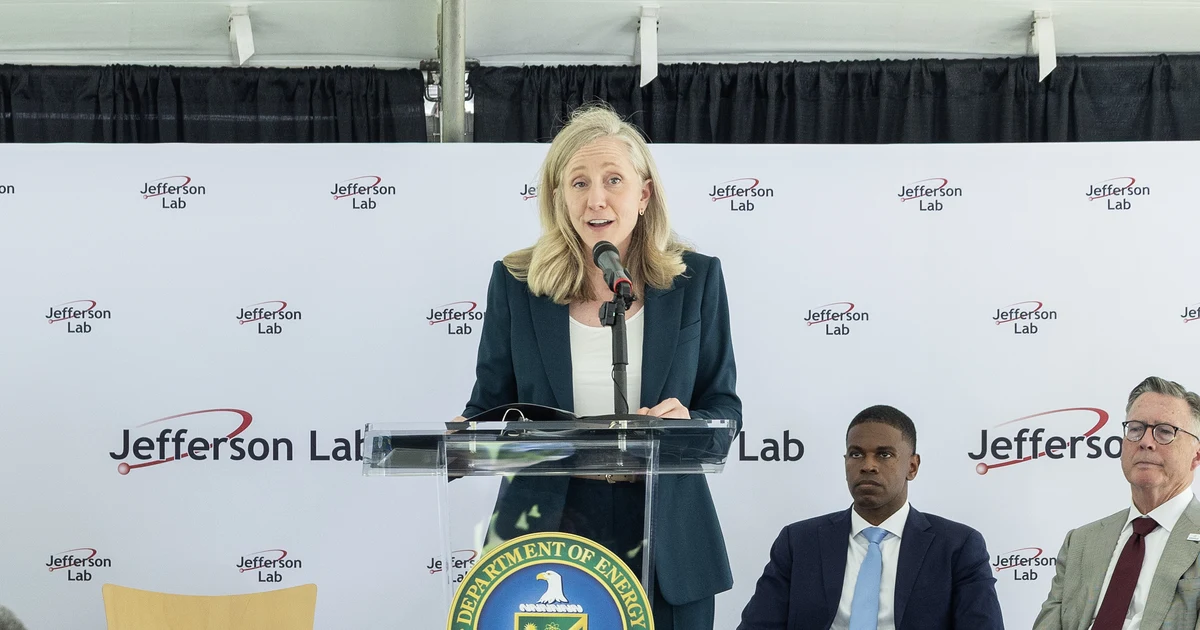
Gov. Abigail Spanberger (D) used her Friday revenue update to count the money: $25 million from Virginia’s new data center tax, and that covers only the first two months.
Officials expect it to reach $90 million or more once utilities with older payment systems pay up. They are “optimistic” about the $600 million a year she promised.
That same Friday, Oct. 16, the news broke that State Sen. Russet Perry (D-SD-31, Loudoun), the Democrat who represents Data Center Alley, had filed a bill to stop approving new data centers across Virginia for three years.
Read that again. One party counts the money with one hand and files a freeze with the other. Two weeks before an election, Virginia Democrats cannot tell you what a data center is.
A cash machine, or a problem.
How did we get here? This summer, as the budget passed, one of the Senate’s top Democrats, Sen. Louise Lucas (D-Newport News), proposed ending the industry’s sales-tax exemption, and lawmakers said no and kept the break.
Democrat majorities carried that budget, as we covered last week.
What they added instead was a new tax on the power data centers burn: 1.1 cents per kilowatt-hour.
It was projected at up to $600 million a year, with some of that money earmarked for Fairfax schools, Metro and transit. Spanberger said the tax makes sure the industry “pays its fair share”.
So the June plan was simple. Keep the data centers coming. Keep the tax break.
Tax the power. Spend the money. The first checks are already allocated, expected to go to education and health care.
Then her own party started filing freeze bills.
Perry’s Senate Bill 843, filed with State Sen. Danica Roem (D-SD-30, Prince William), would block new data center approvals statewide from July 2027 until July 2030.
That covers local governments and the two state agencies that sign off, DEQ and the SCC. It also covers the power lines, grid hookups and on-site generators built just to serve them.
Her reason: “The people of Virginia just continue to be saturated, and it’s not just with data centers,” Perry said, adding, “I don’t know how we can responsibly continue to just keep approving more.”
“The bill is really just a three year pause to take a look and stop more data centers being shoved down a pipe that is already overflowing,” she told WTVR.
Translation: the Democrat from the industry’s home turf says Virginia has had enough.
She is not alone. Roem is filing her own bill for the session that opens Jan. 13: no new approvals until the “hundreds of data centers already awaiting power” get it.
Del. Irene Shin (D-HD-8, Fairfax) has a bill, carried over to 2027, to pause local approvals until pending grid hookups are filled or July 1, 2028, whichever comes first.
Loudoun’s Board of Supervisors voted 7-1-1 on Sept. 15 to draft a 12-month pause on new applications. The board chair insists it is “not a ban or a moratorium”.
The final vote is scheduled for today, Tuesday, Oct. 20, with 33 applications in the pipeline; the proposed pause would reach back to Sept. 15.
Loudoun’s congressman, Rep. Suhas Subramanyam (D-VA-10), said it in September: “we put too many data centers here.”
Asked about a state moratorium, he said, “So, yes, I would support a state moratorium because it doesn’t make sense to be building all of the data centers in one place.”
On Oct. 9 he wrote state regulators about Dominion’s Golden to Mars line, a project estimated at $513 million and designed to push more power into Data Center Alley.
The fallback route would plant a 165-foot monopole in the middle of one woman’s backyard. He asked for three new routes and wrote that “we cannot place the data center industry’s need for electricity on the backs of Virginians.”
In July, Spanberger sat for a Politico interview. Some Democrats in Congress wanted a moratorium, and she argued against it.
On Sept. 18 she signed Executive Order 22 to get her “Data Center Accountability Framework” moving ahead of January.
The order took effect on the spot. Her agencies can’t sign new secrecy deals that hide key details about proposed data centers, except in extraordinary cases.
The big change, ending by-right local approval for centers over 25 megawatts, needs the General Assembly when it meets in January. The framework has no moratorium.
Asked why she had not imposed one while lawmakers consider her framework, Spanberger did not answer directly, according to Virginia Mercury.
She has not accepted calls for a statewide moratorium. When Perry and State Sen. Richard Stuart (R-King George) asked her to call a special session on water policy before January, she denied the request.
Translation: the Governor offered a tax and a framework that leaves out a moratorium. Her own party’s senators filed pause bills. Asked the one question that connects the two, she gave a sideways answer.
Republicans did not need a reporter to ask.
State Sen. Glen Sturtevant (R-Chesterfield) has been calling for an indefinite moratorium for months, and of Perry’s bill he said, “I’m very happy to see that this is now becoming a bipartisan issue.”
You can argue a freeze either way. Here is what you cannot argue. Our county has real money riding on the answer.
We would like Virginia Democrats to say what happens to it under a freeze.
Data centers paid about $110.6 million into Fairfax County’s General Fund in tax year 2026, about 1.9 percent of FY 2027 General Fund revenue; as of August 2026, 20 standalone centers were running here and 11 more were being built.
The county’s own math: three pennies on the real estate tax rate, or about $260 on the average homeowner’s bill. Most of it is tax on the equipment inside, which the county taxes on a depreciation schedule.
So it is not a fixed number.
Next door, data centers brought Loudoun $1.2 billion last year, 39 percent of its whole budget. This year’s budget counts on $1.3 billion, or 40 percent.
Even the electrical workers’ union sees where a freeze goes. “I don’t think a moratorium is gonna pass because you’re taking out your tax base, you’re taking out your jobs,” said Don Slaiman of IBEW Local 26.
A statewide pause on new approvals could affect how much Fairfax adds down the road.
The bill targets new approvals; projects already approved but still waiting on permits or power “raise legal questions about vested rights, and we’ll respect the law on that,” Perry’s office told The Center Square.
So the people who promised $600 million a year from data centers now have a problem. Their own senators are filing freezes. Their Governor was asked why she had not paused them, and she gave no direct answer.
They have a union warning that a freeze takes out the tax base. Somebody in charge owes us the arithmetic.
That is only the tax side. We covered the power bills already. Spanberger signed the carbon permit program on June 30.
Dominion had already put a price on it: about $13 a month for a typical customer, or $10.36 a month if stretched over two years. Regulators had not signed off yet; their hearing is Oct. 28.
Subramanyam is on the Nov. 3 ballot, and VA-10 reaches into southern Fairfax. He says he would back a state moratorium. His opponent is Republican Dave Beckwith, a retired Air Force colonel.
Early voting in Fairfax runs through Saturday, Oct. 31, with 13 more sites opening Thursday, Oct. 22, and Saturday hours on Oct. 24 and Oct. 31 from 9 a.m. to 5 p.m., and Election Day is Tuesday, Nov. 3.
They kept the break, wrote the tax, counted the money and filed a freeze. The Governor got a direct question and gave a sideways answer. In VA-10, Nov. 3 is your chance to give her party a direct one.